
Snapshot / Summary
As we are well into the first quarter 2023, many crypto investors are left with uncertainty even as bitcoin and ethereum are bouncing back from the lows. The widespread distress in crypto during 2022 has left scars on investors. But a bear market is often a good time to find opportunities and the next winner at a reasonable price. This actually doesn’t just apply to crypto, as illustrated by the famous Warren Buffet quote “Be greedy when others are fearful”. The Big Short investor Michael Burry made the statement that crypto may not be investable until people swear off of it. It seems like we were definitely closer to that point than before during the trough of 2022.
Timing the market is extremely difficult, so this is not to say now is the perfect time to buy and expect a bull run. But if you are on the constant look out for good opportunities, you shouldn’t let this bear market stop you. Despite this bear market, three major reasons for investing in crypto still hasn’t changed:
- Real use cases still exist
- Adoption and innovation at the institutional level still happening
- Headwinds that we are experiencing are largely unrelated to the core thesis of blockchain
We’ll dive into more of each of the details below.
Real Use Cases Still Exist
The biggest thesis for the long-term sustainability of crypto is that real use cases continue to appear. While use cases early on for crypto were fairly difficult to identify, these cases span across various industries from finance, tech, to gaming. Even traditional finance veterans such as Bill Ackman listed some real use cases he saw in blockchain (and invested in certain projects)!
Let’s discuss a few examples of real use cases below.
Democratizing Access Through Tokenization and Increasing Liquidity
Tokenization, though not without its unique set of issues, is generally cheaper and more efficient compared to traditional capital raising methods. Typically, it is a burdensome process to sell ownership of an asset or company to raise capital. Traditional methods include having multiple owners of an LLC, crowdsourcing, or even doing an initial public offering. It is usually extremely difficult and burdensome for companies to undertake any of the mentioned capital raising methods. Additionally, there are usually restrictions and hurdles in raising capital from interested parties from other countries. For example, if a residential property is bought in the US, it is not easy to share ownership with international investors.Tokenization of a residential real estate property, such as what the company lofty.ai offers, potentially allows a wider pool of investors to access US residential real estate through buying tokens. The ability to actively trade tokens also increases the liquidity of an illiquid asset. In our real estate example, investors can potentially easily liquidate their partial ownership of a residential property through selling their tokens in the market.
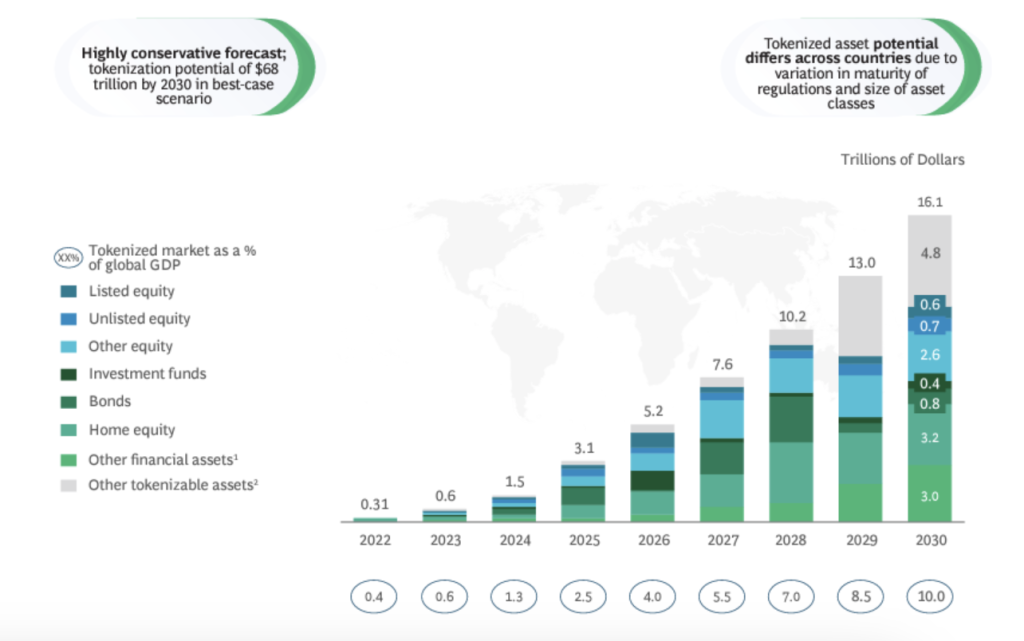
Currently, tokenization is somewhat of a gray area in the United States due to regulation being actively discussed. However, not all countries have implemented strict regulations on tokens.Globally, tokenization of illiquid assets still is estimated to be a $16.1 trillion dollar industry by 2030 according to research provided by the Boston Consulting Group.
Expanding Collaboration for Gaming
It has always been difficult for games across different brands to collaborate. The beauty of having a layer 1 for gaming, such as Oasys (please see our report for it here), is that games will be essentially created in the same ecosystem. This enables games across various platforms to collaborate. For example, the popular game Pokemon is available on mobile and various consoles. Players who play Pokemon on one platform (such as mobile) are sometimes able to transfer Pokemon to another platform (such as a console system). But currently, it is difficult for games that are not from the same brand or ecosystems to collaborate. If a collaboration between Pokemon and Fortnite was somehow contemplated, current technologies will require both sides to do a lot of additional work to integrate the two ecosystems. This would be largely simplified if both games were built in the same layer 1 protocol. An example of this could be transferring in-game characters or items between the two games via NFTs. It will become easier for games to give users playing one game incentives to play another through collaboration of in-game ecosystems.
Community Voting and Participation
Blockchain allows projects or companies to create a voting system where users can directly participate in a project. This is commonly done through Decentralized Autonomous Organizations, or “DAOs”, where users can essentially vote to make major decisions for an organization. A traditional way for companies to do this is for shareholders to vote through proxies, which can be very cumbersome. Voters have to usually receive a physical copy of a proxy or some sort of code to enter online. Whereas through a smart contract, voting can be directly conducted on a social network like Discord, where the community can engage with each other and actively discuss topics prior to voting.
Adoption and Innovation at the Institutional Level Still Happening
We’ve seen the potential of how rapidly blockchain can be adopted by the masses. For example, Axie Infinity experienced exponential growth back in 2021 when internationally many users saw a monetary opportunity through playing the game. Although retail sentiment has somewhat soured, institutions are finding ways to participate in blockchain . Various large wall street financial firms have used tokenization of assets as a method of entering the space. Adoption that is actively being explored by large institutions. A perfect example of this is how KKR announced its tokenized private equity feeder fund in September 2022. This tokenized offering will allow investors to invest for as little as $100,000, a 98% decrease from its traditional $5.0 million buy-in of on its typical feeder fund. This will give a much wider pool of U.S. participants access to KKR’s fund, making it essentially a win-win situation for all parties.
On the consumer finance front, Mastercard partnered with Unbanked (a digital asset platform that allows consumers in certain countries to use their bank account to buy cryptocurrency) to issue a crypto credit card in Europe.
It will be easier in the future for adoption to occur as many existing gaps and weaknesses of blockchain are actively being addressed by new technology. For example, existing layer 1s such as ether have scaling and security issues. New layer 1s such as Sui (see our report here) and Aptos are created with coding developed specifically for crypto and addressing the scaling and security issues mentioned. Other layer 1s, such as Oasys that was previously mentioned, are created specifically for gaming and addressing gas fees and scaling issues that plague existing games built on blockchain.
Despite the bear market that started in 2022, there was still a lot of capital flowing into this space – a sign that a lot of influential institutions believe in it. $30.3 billion and $36.63 billion of VC money was invested in the blockchain space during 2021 and 2022. Capital goes hand in hand with innovation and usually takes some time for projects to realize the benefits of capital investments. With $36.63 billion invested in various new innovative projects over the past year, we could be in a period where the next 10xer, or higher, is preparing to issue tokens.
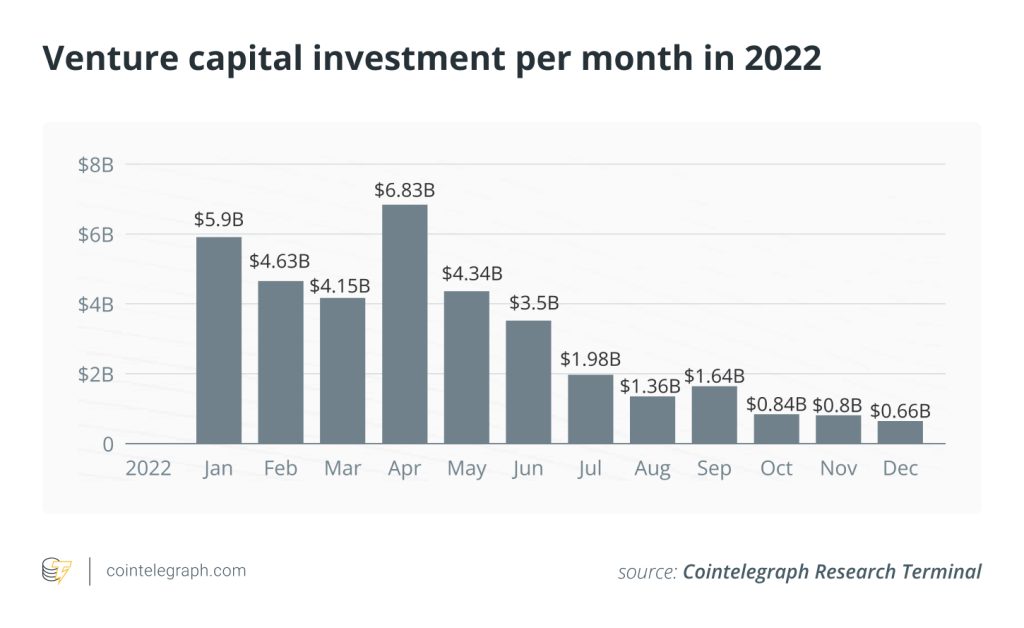
2023 has had a slow start, as we have tracked approximately $500 million in VC investments in the month of January (you can see our weekly newsletter here). But venture capital activity may pick up again as the industry starts to stabilize. Some venture capitalists are also seeing this time to invest in new projects at a good valuation.
Headwinds Largely Unrelated to Crypto Thesis
The widespread distress we saw in 2022 largely relate to regulation, internal controls, risk management, and transparency. While there are many critical lessons to be learned from the debacles, they do not negate any existing thesis in crypto. When peeling back the onion we can see that blockchain technology is still innovative and still has many applications. The distress we have experienced in 2022 does not negate any of this. As mentioned earlier, we at Ruceto believe timing the market is extremely difficult. But we do believe that those who were looking during the bull market should continue to do so. Crypto is a rapidly evolving technology, and what better time to look for potential opportunities when the general public are shying away from the space.